
Smart Building Integration in Singapore: How Existing Facilities Can Connect Legacy Systems Without a Full Overhaul

Existing Facilities Can Become Smarter Without Being Rebuilt From Scratch
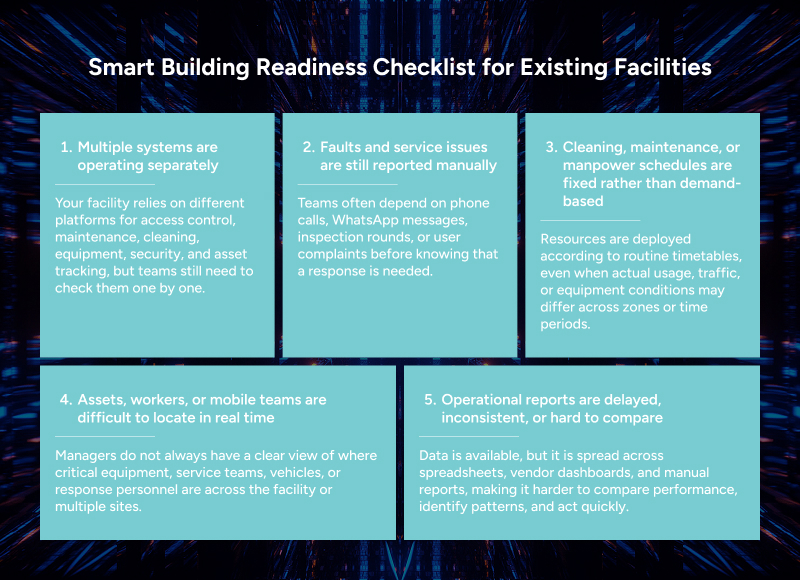
Many commercial, industrial, transport, and institutional facilities in Singapore already depend on several layers of building technology, from access control and lifts to HVAC equipment, meters, cleaning logs, and maintenance workflows. Yet these systems often operate separately, with each platform serving one function and contributing little to a shared operational view.
For example, a facility manager may receive a lift fault alert from one dashboard, an access control notification from another, and a cleaning service update through a separate reporting channel. Although each system works as intended, the manager must piece the information together before deciding what action is required. Bringing these updates into a shared operational view helps the team identify related issues, coordinate the appropriate response, and act with greater speed and confidence.
Facilities may already generate useful data, but it can remain locked inside vendor systems, older building platforms, spreadsheets, dashboards, and manual reporting channels. Teams may still depend on delayed updates, inspections, physical checks, or user complaints before knowing that action is needed.
This is where smart building integration becomes relevant. Instead of replacing every older system, it connects existing infrastructure with IoT sensors, gateways, middleware, APIs, cloud platforms, dashboards, alerts, and operational workflows. The goal is to help facilities understand what is happening, identify what requires attention, and respond faster across building functions.
In Singapore, this approach is practical because many buildings operate under high utilisation, space constraints, manpower pressures, sustainability expectations, and strong service standards. A phased model allows existing facilities to become more intelligent while operations continue. This also aligns with Singapore’s wider digital direction, where connected infrastructure and data-led services are becoming increasingly important to smarter urban operations.
Key Takeaways
- Existing facilities can become more connected without replacing every older system at once.
- A phased approach helps teams improve visibility, response time, safety coordination, and service quality with less disruption.
- Connected data helps facility teams move from manual checks and delayed reports to faster, more informed decisions.
- Connected visibility across facilities, equipment, people, vehicles, and operational assets can help businesses modernise existing operations progressively.
What Smart Building Integration Means for Existing Facilities in Singapore

For many existing facilities, the challenge is not a lack of technology. It is the lack of connection between systems that already support daily operations. Smart buildings are not created by adding devices in isolation. They become useful when data from access systems, HVAC equipment, lighting, lifts, sensors, maintenance workflows, and facility teams can be brought into a clearer operating view. For Singapore buildings that need to improve service quality, manpower efficiency, safety, and sustainability without major disruption, integration provides a practical way forward.
Smart Building Integration Connects BMS, HVAC, Lighting, Lifts, Access Systems, Sensors, and Facility Workflows Into One Operating Layer
In practice, smart integration brings separate building systems, IoT devices, software platforms, workflows, and response teams into a more unified environment, allowing facility data to support operations instead of remaining isolated.
A facility can have smart devices without being truly integrated. When systems do not communicate with one another, teams still depend on manual interpretation and fragmented decision-making.
A connected operating layer allows these systems to work together. Occupancy data can inform cleaning deployment. HVAC performance can be reviewed alongside indoor comfort trends. Lift and equipment alerts can support maintenance planning. Personnel location can support safety and emergency response. Dashboards can consolidate operational data so managers no longer need to move between multiple systems.
Integration does not replace trained facility teams, maintenance planning, or escalation procedures. Its value lies in giving teams earlier signals, better context, and a more reliable way to act on information across systems.
How Smart Building Integration Works
Existing controls and software continue managing functions such as air-conditioning, lighting, lifts, access, and maintenance. Additional sensing devices collect information that the current setup does not provide. Gateways receive data from these sources, while middleware organises it into a consistent format. APIs then transfer the information to a central digital environment, where dashboards, alerts, and work processes help building teams review conditions and respond when action is required.
A sensor overlay can be added where older systems do not capture enough data, such as occupancy, air quality, restroom traffic, equipment usage, vibration, or asset movement. Gateways gather data from devices and systems before sending it to a central platform. Middleware helps organise data from different sources so information can be interpreted consistently. Centralised dashboards allow facility teams to view key conditions, alerts, trends, and response needs in one place.
Legacy Systems Create Blind Spots When Useful Data Remains Disconnected
Many existing facilities were developed, upgraded, and maintained over different phases. Over time, each system may perform its own function but contribute little to a shared operational view. The issue is not always that older building systems are unusable. In many cases, they still perform important functions. The problem is that their data may not be timely, accessible, or connected to the workflows that need it most.
These blind spots create operational consequences. Response slows, manpower allocation becomes less accurate, equipment issues become harder to anticipate, and management teams may struggle to compare performance across sites because data is not standardised.
For Singapore buildings with high daily usage and lean operating teams, these gaps can become costly. Integration helps reduce blind spots by connecting existing data sources, adding new sensing points where needed, and giving teams a clearer view of building conditions.
IoT Overlays, Gateways, Middleware, and APIs Allow Legacy Systems To Stay In Place
A full overhaul is not the only route to a smarter facility. In many existing buildings, the more realistic approach is to build an integration layer around current systems. IoT overlay sensors can capture data that older systems may not provide, such as occupancy, temperature, air quality, vibration, asset movement, equipment usage, or restroom traffic.
For example, an older office building may already use central controls for air-conditioning but have limited visibility into how many people are using each area. Rather than replacing the existing controls, occupancy sensors can be installed to provide live utilisation data. Facility teams can then compare actual space use with air-conditioning activity, helping them identify areas that may require adjustment without replacing the existing infrastructure.
Gateways can collect this data and transmit it to a central platform. Middleware can normalise information from different systems, while APIs allow connected systems to exchange data with maintenance platforms, dashboards, business applications, or command centres.
Because smart building integration connects older systems, IoT devices, cloud platforms, dashboards, and business applications, security and data governance should be considered from the start. A reliable integration model should include secure API connections, role-based access, clear data permissions, controlled vendor access, and ongoing monitoring.
Together, these layers allow existing facilities to modernise without removing every older component. A Building Management System (BMS) can continue managing core building functions while selected data is connected to a broader dashboard. The right IoT platform solutions can help teams connect data sources, structure alerts, and turn operational signals into usable decisions.
A Phased Integration Model Makes Smart Buildings More Practical For Existing Sites
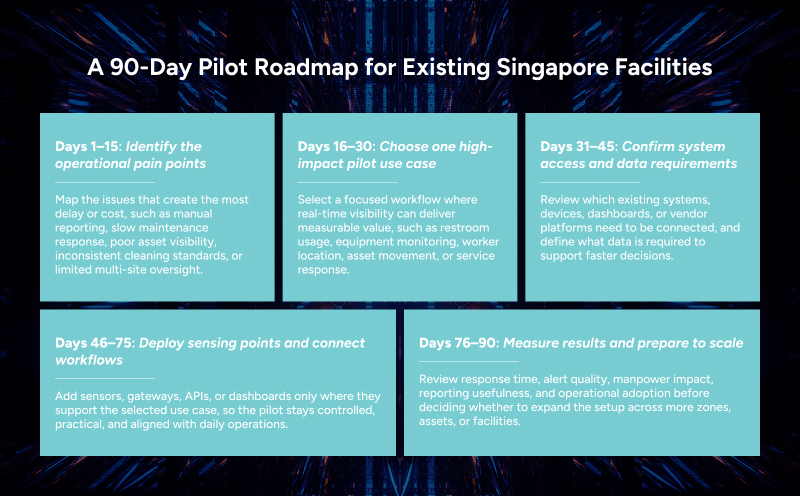
Phased integration can begin with targeted connection points rather than large-scale replacement. For many existing facilities, this is the more practical path because it connects the most operationally important systems first, proves value through specific use cases, and expands the integration layer over time.
The first phase usually begins with visible operational pain points such as slow maintenance response, inconsistent cleaning standards, inefficient manpower deployment, limited equipment visibility, safety concerns, energy wastage, or poor multi-site reporting. Once these pain points are clear, the facility team can identify which existing systems already provide useful data and where new IoT sensing is needed.
In an existing facility, the phased smart building integration may begin with restroom traffic, occupancy patterns, service alerts, equipment conditions, or asset movement. Location-based visibility can also support personnel tracking for emergency response, lone-worker safety, and deployment planning in complex environments.
This phased approach also supports Singapore’s wider move towards more connected digital workflows in the built environment. BCA’s Integrated Digital Delivery approach focuses on using digital technologies to connect stakeholders across design, construction, and asset management. While that framework is broader than facility operations alone, it reinforces the value of connected information across the building lifecycle.
Smart Building Integration Supports Energy Visibility, Maintenance Efficiency, Occupant Comfort, and Long-Term Adaptability
A strong strategy should support wider building performance, not only asset tracking or alerts. In Singapore, where facilities often rely heavily on air-conditioning, lighting, lifts, pumps, and other building systems, connected data can help teams understand how the building is being used.
Energy visibility begins when data from HVAC systems, lighting, meters, occupancy sensors, and equipment is easier to view and compare. Facility teams may identify equipment running outside expected hours, areas with low occupancy but high energy use, recurring temperature complaints, or systems that require maintenance.
For example, a facilities team may find that air-conditioning continues running on an office floor after most occupants have left, while a similar floor with comparable equipment uses less energy during the same period. By comparing occupancy, operating hours, and equipment performance, the team can investigate whether schedules, controls, or maintenance issues are contributing to the difference and make targeted adjustments based on actual usage patterns.
Maintenance efficiency improves when teams move from fixed inspection routines to a more targeted response. Occupant comfort also becomes more measurable because integrated data can show where air quality, temperature, restroom demand, or response times may affect user experience.
This is where smart building integration becomes more than a backend technical upgrade. With better real-time monitoring, facility teams can see what is happening sooner, respond with less delay, and create a more consistent environment for users, tenants, service providers, and operators.
How Overdrive Makes Smart Building Integration Practical for Real-Time Operations
For existing facilities, integration becomes useful only when it supports the way operations happen on the ground. Building teams manage fixed systems, people, vehicles, equipment, service requests, safety risks, cleaning schedules, contractor movement, and time-sensitive incidents. Overdrive’s role is to make these moving parts easier to monitor, connect, and act on through real-time IoT visibility.
Overdrive Connects Facilities, Equipment, Personnel, And Operational Assets Into One Real-Time View
Overdrive’s IoT solutions in Singapore are designed to connect and monitor multiple operational layers, including vehicles, machinery, facilities, and personnel. Our platform supports real-time operational visibility and tracking, with solutions for airport management, worker location, fleet management, waste management, smart toilets, equipment monitoring, logistics, and warehouse operations. In connected building operations, this supports businesses that need more than isolated smart devices.
Overdrive connects information from existing building systems, IoT sensors, BLE devices, GPS trackers, equipment monitors, APIs, and operational workflows through a unified platform. Data from these sources is collected, organised, and presented through dashboards, alerts, reports, and automated workflows, giving teams a clearer view of what is happening across the facility. Rather than replacing every system, we help organisations connect selected operational data so teams can respond faster, coordinate actions more effectively, and use their current infrastructure more efficiently.
A facility manager may need to know whether equipment is being used efficiently, cleaning teams are responding to actual demand, service staff are deployed across the right zones, and assets are moving as expected. Our real-time asset monitoring capabilities support this by helping teams track location, usage, and activity across different operational touchpoints.
This makes our platform relevant for businesses looking at connected building operations as an operational capability, rather than a one-off technology installation.
Overdrive’s API Development and Integration Service Helps Existing Systems Work Together
Smart building integration often succeeds or fails at the system connection layer. Existing facilities usually already depend on software tools, vendor systems, internal applications, legacy platforms, and operational reporting workflows. Replacing them all at once is rarely practical. Connecting them intelligently is often the more efficient path.
Overdrive’s API development and integration service helps businesses connect existing applications, operational platforms, and IoT systems. This approach is also reflected in our brownfield building interoperability work, where the focus is on helping fragmented building systems communicate through a scalable integration layer. For existing facilities, the goal is not to force every system into one vendor environment, but to make useful data accessible, standardised, and actionable.
The value of API integration is operational. It reduces duplicate data entry, improves visibility, speeds up escalation, and allows teams to use existing systems more effectively.
For example, when a sensor detects an equipment issue, the connection layer can pass the alert to the facilities management platform, generate a work order, notify the assigned contractor, and update the central dashboard. This allows information to move between systems automatically, reducing manual handovers and helping the responsible team act sooner.
Overdrive’s Full-Cycle IoT Development Supports Phased Deployment From Problem Definition To Long-Term Optimisation
Connected facility deployment is rarely a simple plug-and-play exercise. Each building has its own infrastructure, vendor history, operating routines, manpower constraints, and performance expectations. A solution that works in one facility may need to be adapted before it works in another.
Overdrive’s full-cycle IoT development capability supports the journey from operational problem definition to solution design, development, integration, deployment, visualisation, and ongoing support. The process begins with the business challenge, not the device. This keeps the integration focused on measurable outcomes such as faster response, better asset utilisation, improved safety, reduced manual reporting, stronger energy visibility, and clearer accountability.
A phased project can begin with one high-impact use case, such as a smart toilet solution, equipment monitoring, or worker location visibility, before expanding into broader smart building integration. This reduces the risk of overbuilding the system before operational value has been proven.
Overdrive Helps Real-Time Building Data Become Real-Time Operational Action
The real value of smart building integration is not simply having more data. It is having data that helps teams act faster and more accurately. Overdrive’s platform and development capabilities are most relevant when they convert real-time signals into operational responses.
For smart toilet operations, restroom traffic and usage data can help facility teams move away from fixed cleaning schedules and respond based on actual demand. Our Smart Toilet Management System provides real-time data on restroom traffic through connected devices and supports cleaning schedules and resource optimisation.
Equipment monitoring can help identify unusual usage patterns, asset inactivity, abnormal conditions, or maintenance needs. Our solution uses sensors, real-time data tracking, and customised software to monitor key metrics, with applications in predictive maintenance and performance optimisation.
For worker location visibility, location-based data can support safety, emergency response, and operational coordination in large or high-risk environments. Our solution helps monitor workers in real time, including at remote job sites, and is positioned to improve safety and reduce industrial accident risks.
Common Use Cases of Smart Building Integration
Connected data becomes more valuable when it is applied to specific facility workflows. For Overdrive, these use cases are especially relevant because its IoT platform supports continuous operational visibility across people, assets, vehicles, equipment, and facility environments.
-
Worker Location Across Facility Operations
Worker location data can help facility teams understand where workers, service teams, or response personnel are located across large or complex sites.
-
Smart Cleaning and Servicing
A waste management IoT solution can support smarter cleaning and servicing by helping teams monitor usage, demand, and collection needs more accurately.
-
Infrastructure Coordination in Airport Environments
Airport management solutions can help connect infrastructure, ground assets, personnel movement, and operational workflows across complex airport environments.
-
Site Mobility and Response Planning
A fleet management solution can support businesses where vehicles or mobile service teams move between facilities, depots, buildings, or operational zones.
-
Integrated Building Systems For Real-Time Operational Visibility
Integrated building systems can bring data from HVAC, lighting, lifts, access systems, sensors, and maintenance workflows into a clearer operating view.
Questions You Might Ask
Can older buildings in Singapore adopt smart building integration?
Yes. Older buildings can adopt smart building integration when the project is planned around connection rather than immediate replacement, with existing systems linked where possible and new sensing added only where visibility is missing.
Does it require replacing all older systems?
No. Many facilities can begin by connecting selected systems, adding IoT devices where real-time data is missing, and centralising operational visibility through dashboards, APIs, and secure workflows.
What is smart building integration, and how does it work?
Smart building integration connects building systems, IoT devices, and facility workflows into a more unified operating view so teams can monitor conditions, coordinate responses, and make faster decisions.
What building systems can be connected?
Facilities can connect systems such as HVAC, lighting, lift monitoring, access control, meters, sensors, maintenance platforms, cleaning workflows, asset tracking tools, and operational dashboards, depending on the site’s current infrastructure and priorities.
How can it support energy efficiency and occupant comfort?
Connected data can help teams identify inefficient equipment use, recurring comfort issues, maintenance needs, and areas where building services should respond more closely to actual usage patterns.
Why are APIs important?
APIs allow different systems to exchange information securely, helping older infrastructure work with newer digital workflows without forcing a full replacement from the beginning.
Conclusion
Smart building integration gives existing facilities in Singapore a practical way to become more connected without disruptive replacement. The strongest opportunity is not in removing every system at once, but in connecting useful infrastructure, adding real-time sensing where visibility is missing, and creating a central operating layer that helps teams act with greater speed, accuracy, and confidence.
Overdrive is well-positioned for this shift because its IoT platform and development services are built around real-time connection across facilities, equipment, personnel, vehicles, and operational assets. Through real-time asset monitoring, API development and integration services, full-cycle IoT development, smart toilet solution capabilities, equipment monitoring, worker location visibility, and supporting fleet management expertise where site mobility is relevant, we help businesses modernise existing operations in a phased and scalable way.
We also help facilities stay adaptable. As building requirements evolve, connected systems make it easier to expand monitoring coverage, integrate new workflows, refine dashboards, and respond to future operational or sustainability expectations without restarting from the beginning. This gives organisations a clearer path to modernisation, where each phase improves visibility and control without overwhelming daily operations.
Start by identifying where smart building integration will create the most immediate impact. Speak with us to explore how real-time IoT connectivity, system integration, and phased deployment can help your existing facility operate with greater visibility, speed, and control.


