
What Is Edge Computing IoT and Why It Matters for Real-Time Operations in Singapore

Why Real-Time Decision-Making Is Now a Business Requirement in Singapore
In Singapore, a delayed vehicle alert, equipment fault, or facility issue can quickly affect an entire operation. Logistics hubs, airports, transport networks, and commercial facilities depend on timely information because even a short delay may disrupt workflows, increase costs, or affect service reliability.
This raises an important question: what is edge computing IoT, and how can it help organisations respond faster at scale?
Collecting data is no longer enough. Businesses also need to process important information close to where vehicles, equipment, and people are operating so teams can act on current conditions.
The growing demand for faster insights has accelerated the adoption of edge computing within IoT ecosystems. Instead of sending every piece of data to a central cloud system for processing, edge-based approaches allow certain data analysis and decision-making processes to take place closer to connected devices and assets.
Edge computing IoT processes data close to the connected device or operational environment instead of sending every data point to a distant cloud server. This allows time-sensitive events, such as equipment faults, vehicle movements, safety alerts, or environmental changes, to trigger faster responses.
Key Takeaways
- Edge-based technologies allow businesses to process information closer to where it is generated, enabling faster responses, improved operational visibility, and stronger control over connected assets.
- Organisations can improve efficiency across vehicles, equipment, facilities, and workforce operations by using connected data to support better coordination and more informed decision-making.
- Successful adoption requires careful consideration of factors such as security, system integration, scalability, and understanding what edge computing IoT is when managing distributed connected systems.
- Businesses can strengthen operational resilience by integrating edge capabilities with existing infrastructure to create more connected, scalable, and responsive workflows.
What Is Edge Computing IoT and Why It Matters for Real-Time Operations
Edge computing IoT addresses this challenge by enabling data analysis and decision-making to happen closer to where operational activities take place. Instead of relying entirely on centralised cloud processing, organisations can handle time-sensitive information closer to connected assets, helping teams improve visibility, respond more efficiently, and manage complex operations with greater precision.
What Is Edge Computing IoT: A Clear and Practical Definition
What is edge computing IoT? It refers to a distributed computing approach where data generated by connected devices is processed and analysed closer to the source, instead of being sent entirely to a centralised cloud system. By moving computing capabilities closer to operational environments, organisations can reduce delays, improve system responsiveness, and support faster decision-making for time-sensitive activities.
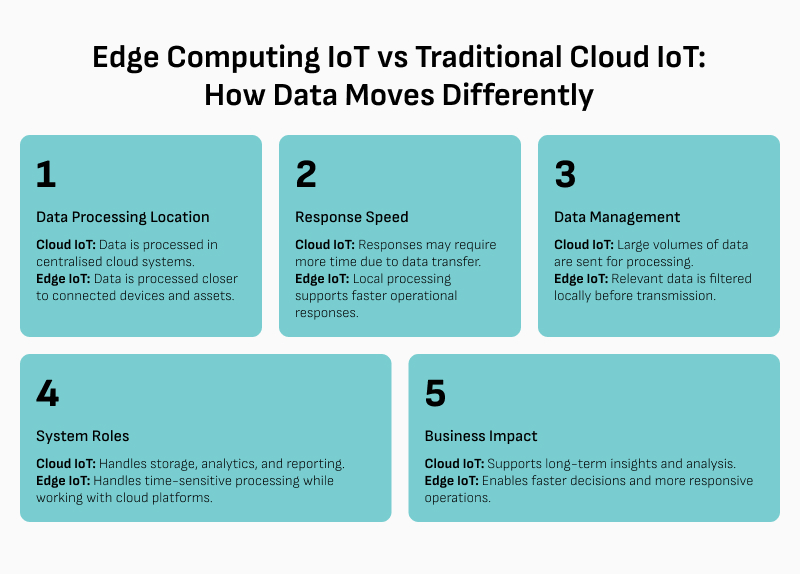
Unlike traditional cloud-based IoT architectures that depend on sending data to remote servers before processing takes place, edge computing enables certain decisions to happen directly at the point where information is generated. This reduces the impact of network delays and allows connected systems to respond more quickly when conditions change.
Consider an airside vehicle approaching a restricted airport zone. In a cloud-only setup, location data may need to travel to a remote server before the system determines whether to trigger an alert. With edge processing, the vehicle or a nearby gateway can evaluate the location locally and warn the driver sooner. The cloud platform can still store the event for reporting, analysis, and operational review.
Edge computing systems typically use embedded computing units, automated rules, and analytical capabilities to process information locally. Through edge device analytics, connected devices can filter, analyse, and interpret incoming data streams before sending selected information to cloud platforms for wider reporting, long-term storage, or strategic analysis.
How Edge Computing IoT Works
Instead of relying on a single central system to manage every data request, processing responsibilities are distributed across connected devices, edge infrastructure, and cloud platforms.
The process typically involves several key stages:
- Sensors and connected devices generate continuous data streams from vehicles, equipment, facilities, or personnel. These devices may capture information such as location, movement, environmental conditions, usage patterns, or operational status.
- Edge devices or gateways perform local data processing within the operational environment. This allows important information to be reviewed and acted upon without waiting for communication with a central server.
- Analytical systems identify patterns and trigger responses.
- Relevant information is filtered before being transferred to cloud platforms.
- Cloud systems support long-term analytics, reporting, and strategic planning.
Why Edge Computing IoT Matters: Operational Advantages That Enable Real-Time Execution
Edge computing IoT is becoming increasingly important because organisations need more than data collection. They require systems that can transform information into timely actions, especially in industries where operational decisions must be made quickly. Understanding what edge computing IoT is allows businesses to recognise how processing data closer to its source can improve responsiveness, strengthen reliability, and support more effective workflows.
For decision-makers evaluating digital transformation strategies, knowing what edge computing IoT is provides a clearer understanding of how connected systems can support faster and more reliable operations.
Ultra-Low Latency for Immediate Response
By reducing dependency on network round trips and remote processing queues, edge computing allows connected systems to respond faster when time-sensitive conditions occur. This is a key reason why organisations exploring what edge computing IoT consider low-latency processing essential for real-time operational requirements.
Reduced Bandwidth Usage and Lower Operational Costs
By filtering and processing data locally, edge computing reduces the amount of information that needs to be transferred to cloud platforms. Instead of transmitting every data point, systems can prioritise relevant information while reducing unnecessary network usage.
Improved Reliability in Variable Network Conditions
Edge-enabled systems can continue performing selected local functions when connectivity becomes slow or temporarily unavailable. Depending on the system design, this may include recording data, issuing alerts, applying operational rules, or storing events until the connection returns.
Stronger Data Control and Compliance Alignment
Local processing can give organisations greater control over which information leaves an operational site or device. However, edge computing does not automatically ensure compliance. Businesses must still apply appropriate access controls, retention policies, security measures, and data governance practices in line with Singapore’s Personal Data Protection Act.
Scalability Across High-Volume IoT Deployments
Edge computing supports large-scale IoT deployments by distributing processing workloads across multiple connected devices and locations. This reduces pressure on central systems and allows organisations to expand connected operations without significantly affecting performance.
Operational Trade-Offs and Implementation Considerations
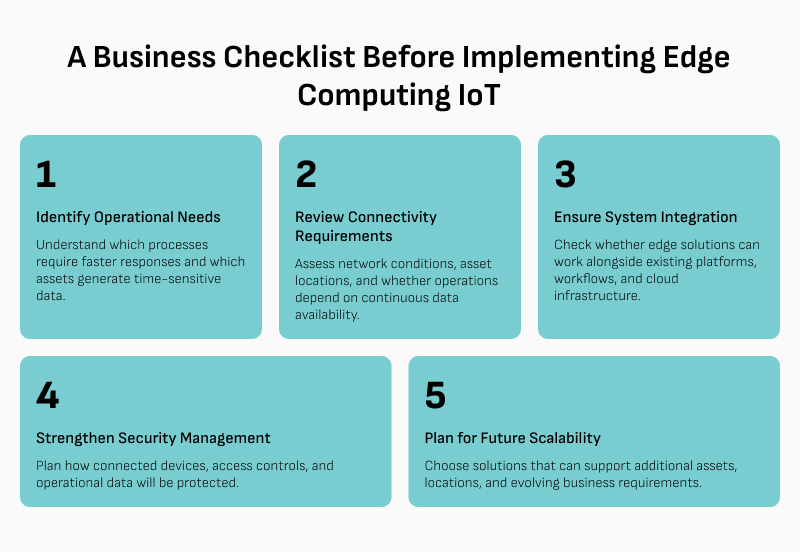
While edge computing provides significant benefits, organisations must also consider the practical requirements involved in implementation. A successful deployment requires careful planning around infrastructure, security, system management, and data coordination.
Security Management Across Distributed Nodes
Distributing processing across multiple edge devices increases the number of connected points that require protection. Organisations need appropriate security measures, including access controls, monitoring, and regular updates, to maintain system reliability.
Increased Operational Complexity
Managing multiple edge devices, software versions, and data workflows can introduce additional operational requirements. Businesses need effective management processes to ensure that connected systems remain coordinated and perform consistently.
Higher Initial Deployment Investment
Implementing edge infrastructure may require upfront investment in hardware, integration, and system design.
Data Synchronisation and System Consistency
Maintaining consistency between edge systems and central platforms requires structured data synchronisation strategies. This is particularly important for organisations operating across multiple locations where connectivity conditions may vary.
Why Edge Computing IoT Is Especially Relevant in Singapore
Singapore’s infrastructure, connectivity capabilities, and focus on digital transformation create a strong environment for edge-enabled operations. Understanding what edge computing IoT is helps businesses recognise how this approach supports faster processing, improved reliability, and more responsive management of connected assets in Singapore’s operational landscape.
5G-Enabled High-Speed Connectivity
Singapore’s 5G networks can support high-speed communication across connected devices and edge infrastructure. However, edge computing does not require 5G. It can also operate through 4G, Wi-Fi, Ethernet, LPWAN, or other networks, depending on the use case.
Smart Nation and Urban Infrastructure Initiatives
Edge computing supports real-time applications that align with Singapore’s Smart Nation initiatives, including intelligent transport systems, smart traffic management, and public infrastructure monitoring. By understanding what edge computing IoT is, organisations can better evaluate how decentralised processing supports smarter infrastructure and more efficient decision-making.
High-Density Operational Environments
Singapore’s compact geography and high activity levels require precise coordination across multiple industries. Logistics hubs, transportation networks, aviation facilities, and commercial properties all depend on efficient resource management.
Operational Reliability Across Critical Sectors
Industries such as logistics, aviation, maritime, and facilities management depend on reliable systems that support continuous operations. Edge computing strengthens resilience by reducing dependency on centralised processing and enabling faster responses where data is generated.
How Edge Computing IoT Translates into Real Operational Impact

While understanding what edge computing IoT is and its technical foundations is important, its true value is demonstrated by how it improves daily operations. For businesses managing complex environments, the ability to process information quickly, identify changes, and coordinate responses can directly influence efficiency, safety, and service reliability.
Driving Real-Time Coordination Across Vehicles, Equipment, and Workforce
Edge computing enables organisations to move beyond basic monitoring into active operational control, where data is continuously processed, interpreted, and acted upon at the point of execution.
For businesses operating across multiple locations, this capability supports faster coordination between assets, teams, and operational processes. Instead of waiting for information to travel through multiple systems before action can be taken, organisations can use real-time data processing to identify important events and respond closer to the moment they occur.
Dynamic Fleet Management with Real-Time Route Adjustments
Transportation operators often manage large fleets that require continuous visibility into vehicle movements, operational conditions, and route performance. Edge computing IoT allows connected systems to analyse relevant information closer to the source, supporting faster responses when circumstances change.
A vehicle tracking system with edge capabilities can process location, movement, driver inputs, and selected vehicle data closer to the source. This may support faster geofence alerts, route deviation warnings, driver notifications, or event detection. Fleet managers can then respond more quickly and coordinate vehicles more effectively.
Instant Equipment Monitoring and Preventive Response
Equipment downtime can significantly affect productivity, particularly in industries where critical assets support daily operations. Understanding what edge computing IoT is helps organisations recognise how edge-enabled systems can process equipment data closer to the source, allowing them to monitor conditions continuously and identify unusual patterns before they develop into larger issues.
By analysing performance data closer to connected assets, businesses can detect potential anomalies and trigger alerts without waiting for central processing. This supports preventive maintenance strategies by allowing teams to address issues earlier, reducing operational disruptions and improving asset reliability.
Responsive Workforce Deployment Based on Live Data
Managing personnel across large operational environments requires accurate visibility into workforce movements, availability, and location. Edge computing IoT supports a more responsive workforce coordination by enabling organisations to analyse relevant information quickly and make adjustments based on current operational needs.
Where appropriate and supported by clear workplace policies, personnel tracking can help organisations understand workforce location, improve deployment, and support safety responses. Businesses should design these systems with privacy, access control, and purpose limitation in mind.
Advancing Facility and Infrastructure Management Through Edge Intelligence
Facilities and infrastructure environments require continuous optimisation to maintain efficiency, reliability, and service quality. Understanding what edge computing IoT is helps organisations recognise how connected systems can monitor conditions, process information closer to the source, and support faster responses across buildings, commercial spaces, and public facilities.
Real-Time Environmental and Usage Monitoring
Edge-enabled sensors provide continuous visibility into facility conditions, allowing organisations to monitor factors such as environmental changes, equipment status, and usage patterns.
Condition-Based Maintenance for Operational Efficiency
Traditional maintenance schedules often rely on fixed intervals, which may result in unnecessary servicing or delayed responses to emerging issues. Edge computing IoT enables a more condition-based approach by using operational data to determine when maintenance activities are actually required.
By identifying performance changes earlier, organisations can reduce avoidable downtime, improve asset lifespan, and ensure that critical systems continue operating effectively.
Adaptive Resource Management in High-Usage Environments
Large facilities often experience changing demand patterns throughout the day. Edge-enabled systems allow organisations to adjust operations based on live conditions, helping improve resource efficiency while maintaining expected service levels.
How Overdrive IoT Delivers Scalable Edge Computing IoT Solutions
A scalable edge deployment requires connected devices, local processing, reliable communications, cloud integration, dashboards, alerts, and device management to work together.
Overdrive connects these components through a unified IoT ecosystem. Depending on the use case, data may come from GPS trackers, BLE devices, RFID systems, sensors, cameras, Mobile Display Terminals, or other connected equipment. Edge logic can support immediate operational responses, while the Overdrive platform provides central visibility, reporting, alert management, and historical analysis.
Unified IoT Platform for End-to-End Visibility
A connected ecosystem allows organisations to monitor vehicles, equipment, facilities, and personnel through a single operational view. Through integrated IoT platform solutions, businesses can bring together information from different sources and create stronger visibility across their operations.
Advanced Edge Processing for Immediate Insights
By processing information closer to connected assets, edge computing enables faster analysis and response. This approach supports low-latency computing, allowing systems to interpret operational data and trigger appropriate actions with reduced delays.
Depending on the hardware, sensors, integration, and configured rules, edge capabilities can support event detection, threshold alerts, local warnings, equipment-condition monitoring, and automated workflow triggers.
For industries operating across multiple locations, distributed IoT systems provide a practical way to maintain responsiveness while managing large volumes of connected data. By distributing processing across different operational points, organisations can improve scalability and reduce pressure on central infrastructure.
Edge Processing in Airside Safety
In an airside environment, a vehicle’s GPS position can be evaluated against predefined restricted zones. When the vehicle approaches a protected area, the system can issue an immediate visual and audio warning through an in-vehicle display. At the same time, the event can be transmitted to the central platform for operational monitoring, reporting, and review.
This approach combines local response with central visibility. The driver receives an immediate warning, while the operations team retains a record of the event.
Customised Solutions Through Full-Cycle IoT Development
Different industries have different operational requirements, meaning edge computing solutions must be designed around specific workflows and business objectives. Understanding what edge computing IoT is helps organisations identify suitable approaches for implementing connected capabilities that align with their existing processes.
Overdrive IoT develops tailored IoT architectures designed to support scalable deployments across different industries.
Seamless Integration with Existing Systems
Integrating new technologies with existing infrastructure is an important consideration for businesses adopting edge computing IoT. Organisations need solutions that enhance current capabilities without requiring the complete replacement of existing systems.
Through system integration and connectivity capabilities, edge solutions can work alongside existing enterprise platforms, allowing businesses to improve operational visibility while maintaining established workflows.
Proven Applications Across Singapore’s Key Industries
Edge computing IoT has practical applications across many sectors where real-time visibility and operational control are essential. Knowing what edge computing IoT is allows organisations to better understand how connected technologies support complex operational challenges across transportation, aviation, smart facilities, and sustainability initiatives.
For example, aviation operators can use connected systems to improve airport asset tracking by gaining better visibility over ground support equipment, operational assets, and movement across large facilities. In addition, waste management companies can adopt an IoT solution to improve collection efficiency, asset monitoring, and operational planning.
Questions You Might Ask
What is edge computing IoT, and how does it improve real-time operations?
Edge computing IoT processes data closer to where it is generated instead of sending all information to central cloud systems. This reduces delays, allowing organisations to respond faster to operational changes, improve decision-making, and support real-time activities across connected vehicles, equipment, facilities, and other assets.
Why is edge computing important in Singapore?
Singapore’s dense infrastructure and fast-moving industries require systems that can respond quickly to changing conditions. Edge computing supports this need by enabling faster data processing for sectors such as transportation, aviation, logistics, and facilities management, where operational efficiency and reliability are critical.
What is edge computing IoT architecture and how does it work?
Edge computing IoT architecture typically includes sensors, edge devices, gateways, local processing capabilities, and cloud integration. Connected devices collect data, edge systems analyse information closer to the source, and cloud platforms support broader analytics, storage, and reporting.
How does Overdrive IOT support implementation?
Overdrive IOT supports implementation through a unified platform that connects vehicles, equipment, facilities, and personnel. With integration capabilities and scalable IoT development, organisations can introduce connected solutions while maintaining visibility across operations and compatibility with existing systems.
Does edge computing replace cloud computing?
No. Edge computing complements cloud computing by handling time-sensitive processing locally, while cloud platforms support analytics, storage, and broader data management. Together, they allow organisations to achieve faster responses while maintaining scalability and long-term operational insights.
What should businesses consider before adopting edge computing IoT?
Businesses should consider factors such as system integration, scalability, security management, data governance, and device lifecycle planning before adopting edge computing IoT. Evaluating deployment requirements and operational complexity helps ensure the solution can support long-term business objectives.
Conclusion

Edge computing IoT establishes a new operational standard by shifting data processing from delayed analysis to immediate execution. Understanding what edge computing IoT is helps organisations recognise how processing information closer to where activities occur allows them to respond with greater speed, accuracy, and confidence in Singapore’s fast-paced and highly coordinated business environment.
By reducing latency, improving reliability, and supporting faster decision-making, edge computing strengthens operational control across complex systems. Organisations that adopt this approach gain greater visibility over interconnected operations, allowing them to respond more efficiently, optimise resource usage, and build more resilient workflows.
With its integrated platform capabilities, advanced edge technology, and full-cycle development expertise, Overdrive IoT supports organisations in building scalable IoT ecosystems designed for real-time execution. By helping businesses understand what edge computing IoT is and how it enables more responsive data processing, Overdrive IoT connects operational data with intelligent processing capabilities to create environments that support long-term efficiency and smarter decision-making.
To move from delayed insights to faster operational control, businesses need solutions that align technology with real-world requirements. Speak with us to explore how edge computing capabilities can be tailored to support your operational objectives, integrate with existing systems, and deliver actionable visibility across Singapore’s evolving business landscape.


